


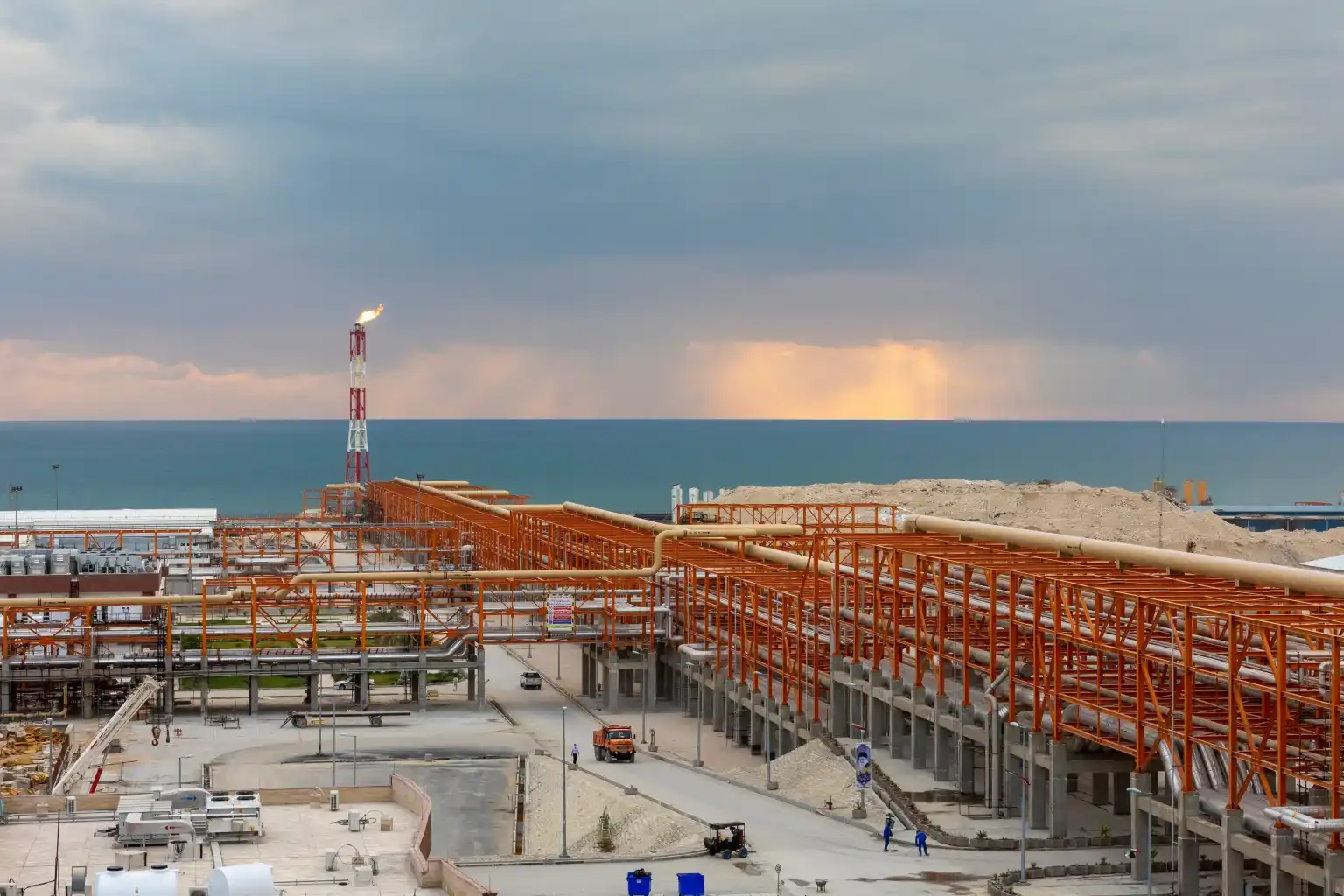
The Kangan Petro-Refinery is one of the major projects aimed at developing the gas value chain and petrochemical industries in the South Pars region. this project initially focused on recovering valuable hydrocarbons from rich gas and subsequently expanding the downstream value chain, giving it an important position in the development of Iran’s petrochemical industry.
The complex is located in Bushehr Province, along the Persian Gulf coast, near Kangan and the South Pars region. Its gas feedstock is supplied from the rich gas produced in the South Pars area. The main objective of the project is to prevent the loss of valuable hydrocarbons and convert them into higher-value products. Published sources have reported the complex’s feed gas capacity at approximately 81 million cubic meters of rich gas per day.
Over the years of execution, the Kangan Petro-Refinery has evolved into a multi-section complex encompassing ethane recovery and utility units as well as olefin and polymer projects. In a project of this scale, the construction of process units is only part of the challenge. A large range of mechanical, piping, electrical, instrumentation, civil works, and industrial building infrastructure must be executed, integrated, and prepared for operation.
Exir Sanat has been involved in various sections of the complex since 2017 and, according to the company’s reported project records (see more about it here) , has carried out or is currently carrying out mechanical, piping, electrical, instrumentation, civil, pre-commissioning, and commissioning-related activities under multiple contracts.
TABLE OF CONTENTS
- What Is the Kangan Petro-Refinery?
- Location of the Kangan Petro-Refinery
- Overall Structure of the Kangan Petro-Refinery Project
- Why Is Ethane Recovery Important in the Kangan Petro-Refinery?
- Utility Units at the Kangan Petro-Refinery
- Exir Sanat Bakhtari’s Role in the Kangan Petro-Refinery Project
- Mechanical Installation at the Kangan Petro-Refinery
- Exir Sanat’s Civil and Architectural Works at the Kangan Petro-Refinery
- Pre-Commissioning and Commissioning Suppor
- Conclusion
- Frequently Asked Questions About the Kangan Petro-Refinery
What Is the Kangan Petro-Refinery?
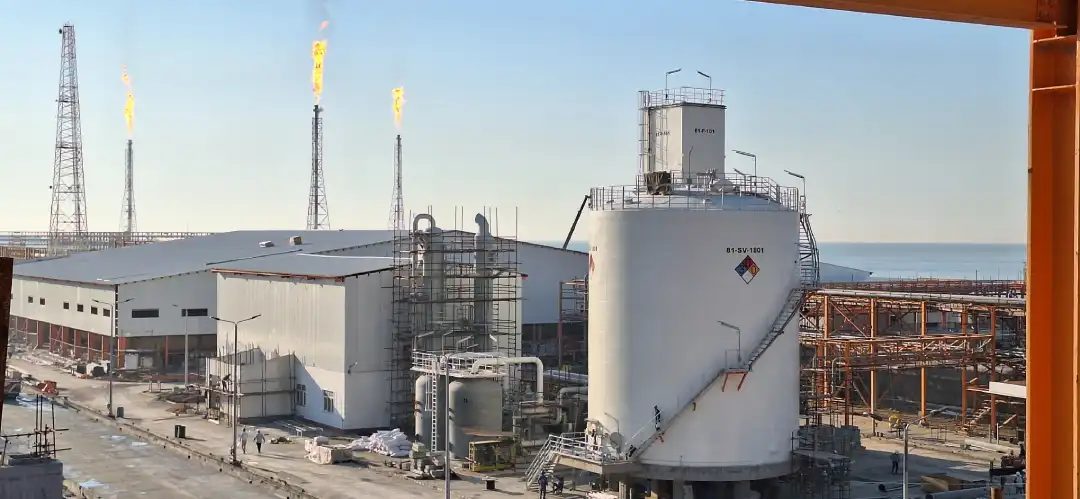
To understand the importance of the Kangan Petro-Refinery project, it is first necessary to consider its feedstock and value chain.
Natural gas extracted from gas fields does not consist solely of methane. Rich gas may also contain hydrocarbons such as ethane, propane, butane, and heavier compounds. Recovering these components instead of allowing them to be lost or flared makes it possible to use them as feedstock for petrochemical units.
One of the main development objectives of the Kangan Petro-Refinery has been the recovery of ethane and other valuable hydrocarbons from rich gas. According to published information, the Ethane Recovery Project includes units for the recovery of ethane, propane, butane, C5+, as well as the required utility facilities.
The importance of this process is not limited to the production of a single product. Recovered ethane can be used as feedstock for downstream units such as olefin and polymer plants, thereby creating a value chain extending from natural gas to higher-value petrochemical products.
For this reason, the Kangan Petro-Refinery should be viewed as part of a larger value chain—one that begins with the receipt of rich gas and continues through the production of petrochemical feedstocks and polymer products.
Location of the Kangan Petro-Refinery
The Kangan Petro-Refinery is located in Bushehr Province, within the Pars Special Economic Energy Zone. Its proximity to South Pars gas facilities is an important advantage for feedstock supply.
According to published sources, the project site is located in the Kangan area, near the South Pars facilities, and the feedstock for the Ethane Recovery Unit is supplied from one of the region’s gas refineries. Specialized project sources have identified South Pars Phase 12 Gas Refinery as the feedstock source for the Ethane Recovery Unit.
This geographical location is particularly important for the project because, in large-scale gas and petrochemical projects, the distance between the feedstock source, process units, and downstream facilities can directly affect the cost and complexity of transfer pipelines, utilities, and supporting infrastructure.
Overall Structure of the Kangan Petro-Refinery Project
The Kangan Petro-Refinery cannot be considered merely a single production unit. The complex consists of several process and support sections that must operate together.
One of the main ways the project can be divided is into two development paths:
Phase 1: Ethane Recovery and Processing
The first phase focuses on recovering valuable hydrocarbons from rich gas. This section includes ethane, propane, butane, and C5+ recovery units, along with the utility units required for operation of the complex.
Phase 2: Olefin and Polymer Value Chain Development
As part of the subsequent development program, facilities have been defined to convert hydrocarbon feedstocks into petrochemical and polymer products. Published sources on the project identify an olefin unit and polyethylene units as important components of its downstream development.
According to reports published in recent years, this value-chain development has included olefin production units as well as high-density polyethylene (HDPE) production facilities.
This structure means that the Kangan Petro-Refinery is more than a gas recovery project. It is a complex designed to create additional value from gas feedstock and support the development of downstream petrochemical industries.
Why Is Ethane Recovery Important in the Kangan Petro-Refinery?
Ethane is one of the major feedstocks used in the petrochemical industry to produce ethylene. Ethylene, in turn, is a key raw material for many downstream products, including various types of polyethylene.
The overall value-creation pathway can therefore be illustrated as:
Rich Gas → Ethane Recovery → Ethylene Production → Polymer Production → Downstream Products
The importance of such a value chain lies in the ability to create value at multiple stages rather than selling or consuming the feedstock at a single stage.
In the case of the Kangan Petro-Refinery, published sources indicate that recovered ethane is converted into ethylene in the olefin unit and subsequently used in polyethylene units.
From this perspective, the project contributes not only to increasing hydrocarbon processing capacity but also to the development of downstream petrochemical industries.
Utility Units at the Kangan Petro-Refinery
No large-scale process complex can operate reliably without utilities. Utility units are responsible for supplying the services required by process units. Depending on the design of the complex, these services may include electricity, industrial water, cooling water, instrument air, service air, steam, nitrogen, and other auxiliary services.
The complexity of utilities in a project such as the Kangan Petro-Refinery comes from the need to coordinate them with multiple process units, transfer systems, electrical and instrumentation equipment, and site infrastructure.
For this reason, utility execution cannot be regarded as merely a supporting activity. It is one of the fundamental components required to prepare the complex for operation.
Exir Sanat Bakhtari’s Role in the Kangan Petro-Refinery Project
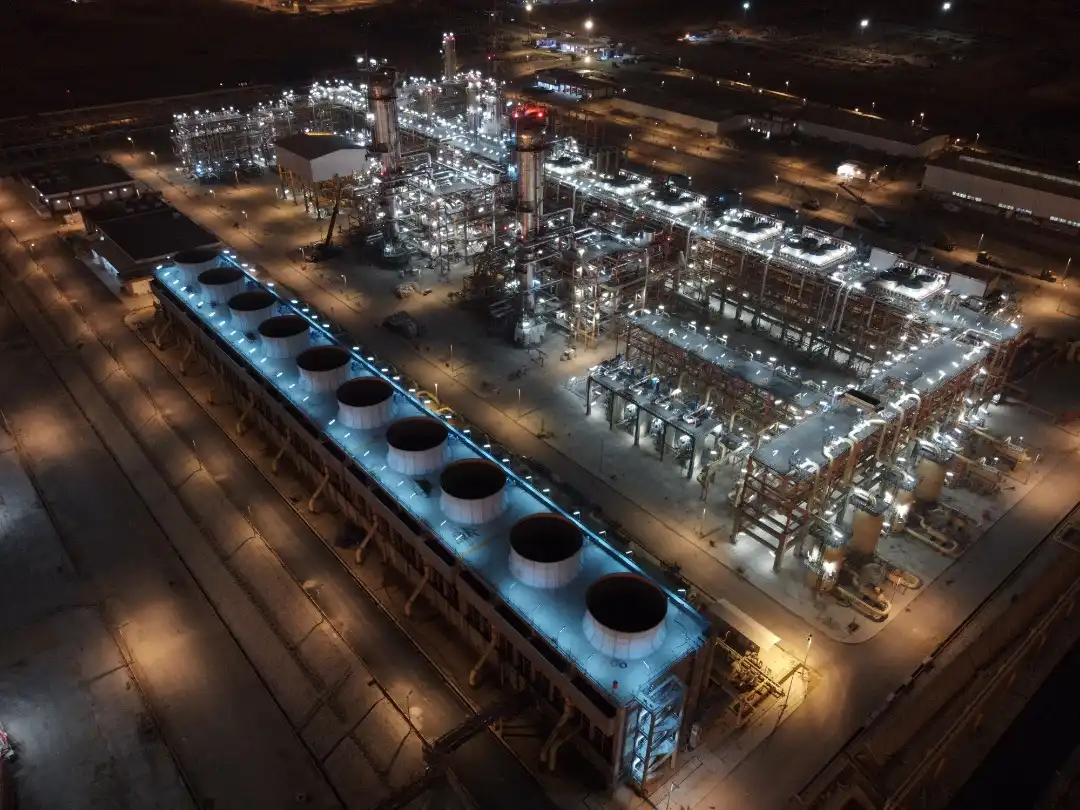
Exir Sanat Bakhtari’s involvement in the Kangan Petro-Refinery is not limited to a single activity. According to project information provided by the company, the company has been active in various sections of the project through multiple contracts since 2017.
The scope of Exir Sanat Bakhtari’s activities covers areas including mechanical works, piping, electrical works, instrumentation, civil works, pre-commissioning, and commissioning.
This broad scope is significant because oil, gas, and petrochemical projects cannot be completed through the construction of a single piece of equipment or installation of a single pipeline. The relationship between equipment, piping, electrical systems, instrumentation, structures, and industrial buildings must be managed in an integrated manner.
Mechanical Installation at the Kangan Petro-Refinery
One of the major areas of Exir Sanat Bakhtari’s work on this project has been the installation of mechanical equipment.
According to the project information, Exir Sanat Bakhtari has carried out the installation of mechanical equipment including:
- Reactors
- Towers
- Heat exchangers
- Pumps
- Process packages and other equipment
with a total weight of approximately 3,000 tons in the utility section.
Installing heavy equipment in a process complex involves much more than transporting equipment from the fabrication or storage area to its installation location. Positioning, elevation and alignment control, foundation preparation, installation, alignment, connection to process systems, and quality inspections are all part of the sequence required to prepare equipment for the subsequent stages of the project.
For equipment such as heat exchangers and reactors, installation accuracy is particularly important because errors in equipment position or elevation can create significant problems during piping connection and operation.
Piping Execution at the Kangan Petro-Refinery: More Than 520,000 Inch-Dia
One of the most significant areas of Exir Sanat Bakhtari’s work on the Kangan Petro-Refinery project has been piping execution.
According to information provided by the company, Exir Sanat Bakhtari has executed carbon steel and stainless steel piping in the utility and offsite sections, totaling approximately 520,000 inch-diameter.
The work has included both aboveground and underground piping, along with related completion activities such as:
- Line painting
- Insulation
- Testing
- Final installation activities
The figure of 520,000 inch-diameter provides a more meaningful indication of the scale of piping work than simply stating the total length of the pipelines. In industrial projects, this metric considers both pipe diameter and length and is therefore a useful indicator for measuring and comparing piping workload.
Piping execution in a process complex also requires continuous coordination among isometric drawings, equipment, supports, structures, underground systems, and final testing activities.
Gas and Feedstock Transmission Lines
Exir Sanat Bakhtari’s activities at the Kangan Petro-Refinery have not been limited to pipelines within the site.
According to the company’s project records, the scope of work has also included the execution of large-diameter transmission lines.
These activities include:
- Construction of 32-inch and 36-inch sour gas transmission lines toward Phase 14 and the HDPE production unit
- Construction of 46-inch and 56-inch feedstock transmission lines from the Ninth Refinery to the Ethane Recovery Unit
Due to their large diameters, the nature of the fluids being transported, and their direct connection to process units, these pipelines require a high level of attention in terms of construction execution, installation, welding, testing, and quality control.
In such projects, route preparation, support installation, welding, non-destructive testing (NDT), pressure testing, and preparation of the pipeline for operation must all be carried out in accordance with the project specifications and technical requirements.
Electrical and Instrumentation Works
Another significant area of Exir Sanat Bakhtari’s activities has been the execution of the project’s electrical and instrumentation systems.
According to the information provided, Exir Sanat Bakhtari has installed approximately 6,000 instrumentation devices and around 15,000 transformers, electrical panels, and other electrical equipment.
The company has also reported approximately 3,100 kilometers of cable installation across the utility and process sections of Phases 1 and 2 of the Ethane Recovery plants.
Instrumentation serves as the nervous system of a process complex. Pressure, temperature, flow, level, and other process measurements must be accurately collected and transmitted to the control system so that the process can operate within its design parameters.
At the same time, the electrical network must safely and reliably supply the power required by process equipment, pumps, compressors, control systems, and auxiliary equipment.
For this reason, electrical and instrumentation installation in a project of this scale has a direct connection with the pre-commissioning and commissioning stages.
Exir Sanat’s Civil and Architectural Works at the Kangan Petro-Refinery
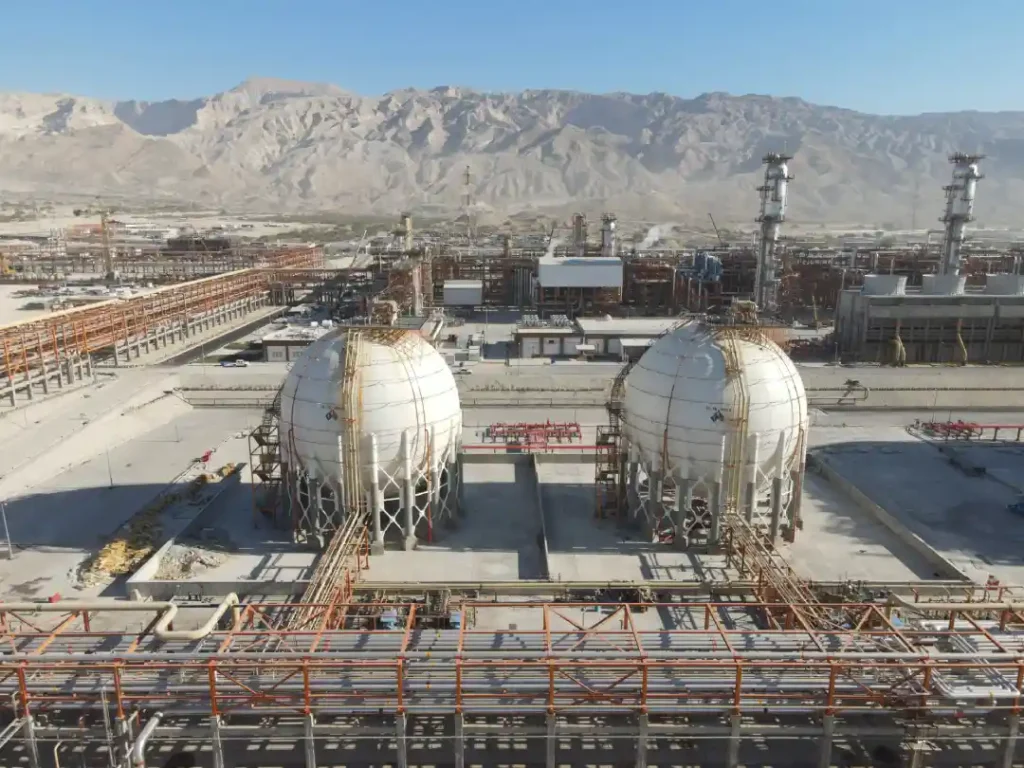
Exir Sanat’s scope of work on this project is not limited to mechanical equipment and systems.
In the civil works section, according to project information, more than 46,000 cubic meters of concrete and approximately 21,000 square meters of architectural works have been executed.
These activities have covered various parts of the project infrastructure.
Industrial and Supporting Buildings
Among the concrete structure and architectural works carried out are:
- Control room
- Electrical substations
- RO unit buildings
- Two-story laboratory building
- Seven-story Kangan Petro-Refinery guesthouse
The construction of these buildings within an industrial complex requires coordination among structural, architectural, electrical, mechanical, and building service systems because industrial buildings form part of the complex’s operational infrastructure.
Cooling Tower Concrete Structures and Ethane Recovery Infrastructure
Another Exir Sanat Bakhtari activity has been the construction of the concrete structure of the cooling tower in Phase 2 of the project.
Cooling towers are used in many process complexes to reject heat from cooling-water systems, and their performance is directly connected to the stable operation of process units.
Exir Sanat has also carried out a range of civil works as part of the Ethane Recovery Project, including:
- Construction of electrical and instrumentation ducts and trenches
- Construction of concrete pipe racks
- Manhole construction
- Valve pit construction
- Site landscaping
- Equipment foundation construction
- Construction of retaining walls
- Construction of the site perimeter concrete wall
The perimeter wall constructed at the Kangan Petro-Refinery site is approximately 4,000 meters long.
Although these activities may receive less attention than the installation of major process equipment, such infrastructure is essential in large industrial projects because it provides the conditions required for safe equipment transportation, installation, operation, and maintenance.
Pre-Commissioning and Commissioning Suppor
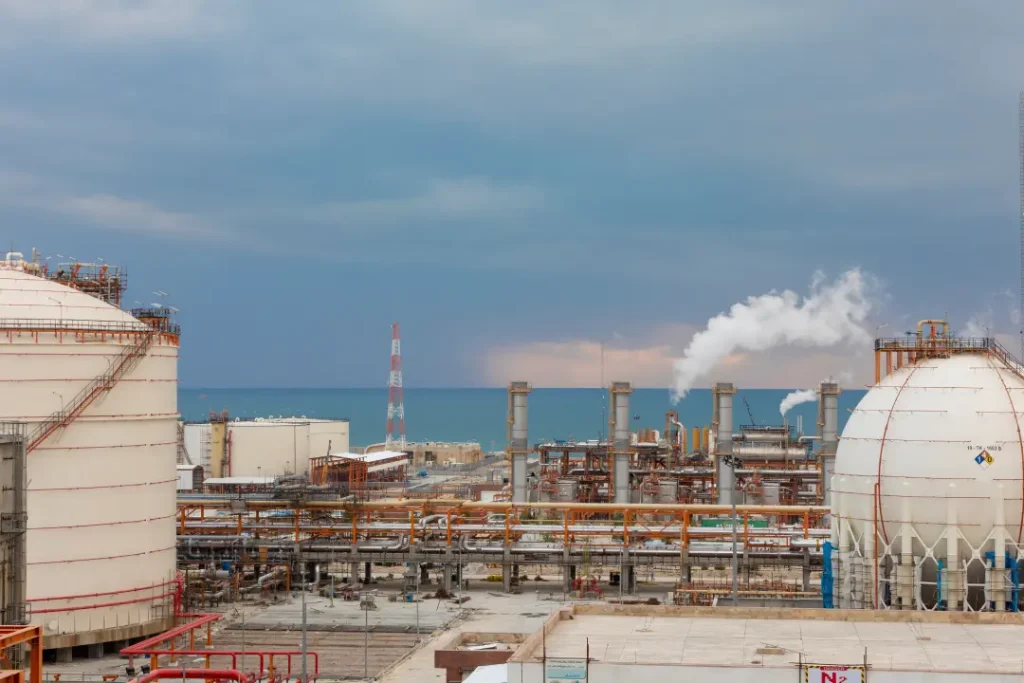
After construction and installation are completed, the project enters a stage in which the quality of previous activities becomes particularly evident.
In addition to construction activities, Exir Sanat Bakhtari has participated in pre-commissioning and commissioning support for sections of the project.
At this stage, systems are prepared for service after completion of installation and the required testing activities.
Activities such as equipment status checks, pipeline testing, inspection of electrical and instrumentation systems, and resolution of outstanding items are part of the process of preparing a unit for operation.
In a project involving such a large number of equipment items and pipelines, successful commissioning requires close coordination among construction, engineering, electrical, mechanical, instrumentation, quality control, and operations teams.
Scale of Exir Sanat Bakhtari’s Cooperation with the Kangan Petro-Refinery
According to the project records provided by Exir Sanat Bakhtari, the company’s activities at the Kangan Petro-Refinery have continued since 2017 and have been carried out or are ongoing under multiple contracts covering different sections of the project.
In the project’s contractual information, the value of activities has been reported as the equivalent of USD 125 million and USD 45.5 million.
Because these figures are presented separately in the available project information and the exact allocation of each amount to a specific contract or work package is not clearly stated, this article does not combine them as a definitive contract value or as the total value of the project.
What is more significant is the scope of activities undertaken by Exir Sanat Bakhtari over these years—a scope extending from civil works and equipment installation to piping, electrical works, instrumentation, and pre-commissioning activities.
Why Is the Kangan Petro-Refinery Project Important for Exir Sanat Bakhtari?
Oil, gas, and petrochemical projects cannot be evaluated solely by the volume of concrete poured or the weight of equipment installed. Their actual complexity becomes apparent when multiple engineering and construction disciplines must operate simultaneously within a single industrial site.
At the Kangan Petro-Refinery, Exir Sanat Bakhtari has been involved in different stages of this chain:
Civil Works → Equipment Installation → Piping → Electrical → Instrumentation → Testing & Completion → Pre-Commissioning → Commissioning
This broad scope creates a different type of experience compared with executing a single isolated activity because every discipline must be coordinated with the others.
For example, installing a heat exchanger without completed foundations, piping, electrical systems, and instrumentation cannot ultimately lead to actual operation. Similarly, installing a pipeline does not end with placing the pipe in position; testing, painting, insulation, supports, and preparation for service must also be completed.
Kangan Petro-Refinery and the Development of the Gas Value Chain
The significance of the Kangan Petro-Refinery is not limited to its technical dimensions.
The complex is positioned within a value chain that converts rich gas into petrochemical feedstocks and subsequently into higher-value products. Published sources have also emphasized the connection between ethane recovery, ethylene production, and the development of polymer units.
At one stage, the project’s Ethane Recovery Unit was described as an important project for supplying feedstock to the petrochemical industry, with its annual product capacity reported at approximately 3.5 million tons.
Developing this value chain means making greater use of the value contained in natural gas and moving from the sale or consumption of primary feedstock toward products with greater added value.
This makes the Kangan Petro-Refinery one of the notable projects in the South Pars region in terms of developing the gas value chain.
Conclusion
The Kangan Petro-Refinery is one of the major industrial projects in the South Pars region, developed with the objective of recovering valuable hydrocarbons from rich gas and creating a value chain extending to petrochemical and polymer products.
The project’s structure extends from recovery and utility units to the development of olefin and polymer facilities. This has made it a multidisciplinary project requiring extensive capabilities in mechanical works, piping, electrical systems, instrumentation, civil works, and commissioning.
Since 2017, Exir Sanat Bakhtari has been involved in various sections of the complex. According to the company’s project records, its activities have included the installation of approximately 3,000 tons of mechanical equipment, execution of around 520,000 inch-diameter of piping, installation of thousands of electrical and instrumentation devices, approximately 3,100 kilometers of cable installation, more than 46,000 cubic meters of concrete works, and approximately 21,000 square meters of architectural works.
Taken together, these activities show that Exir Sanat Bakhtari’s role at the Kangan Petro-Refinery has not been limited to a single project discipline. Instead, its scope has covered a broad range of construction, installation, completion, and commissioning-related activities.
For a contractor active in the oil and gas industry, experience on a project of this scale represents more than a contractual record. It provides an example of the ability to manage and execute multiple disciplines simultaneously within a large and complex process facility.
Frequently Asked Questions About the Kangan Petro-Refinery
The Kangan Petro-Refinery is located in Bushehr Province, within the South Pars region, near Kangan and the gas facilities of the area.
One of the main objectives of the project is to recover ethane and other valuable hydrocarbons from rich gas and use them in the production chain for petrochemical and polymer products.
According to published sources, the feedstock for the Ethane Recovery Unit is supplied from rich gas in the South Pars region, including gas from the Phase 12 gas refinery.
Exir Sanat’s activities have included mechanical equipment installation, piping, transmission lines, electrical and instrumentation equipment installation, cable installation, civil and architectural works, utility and offsite infrastructure, as well as participation in pre-commissioning and commissioning.